Stainless Steel TricyclesInventor


+86 133 9251 2305
+86 133 9251 2305
Hot search keywords: Sanitation Tricyclesmanufacturer Stainless Steel Tricycles Custom Stainless Steel TricyclesPrice
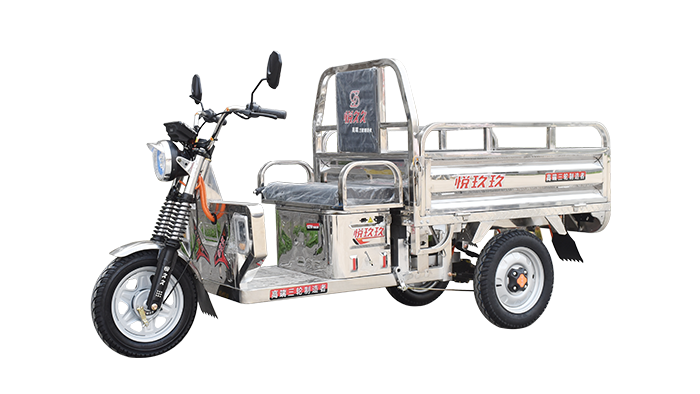
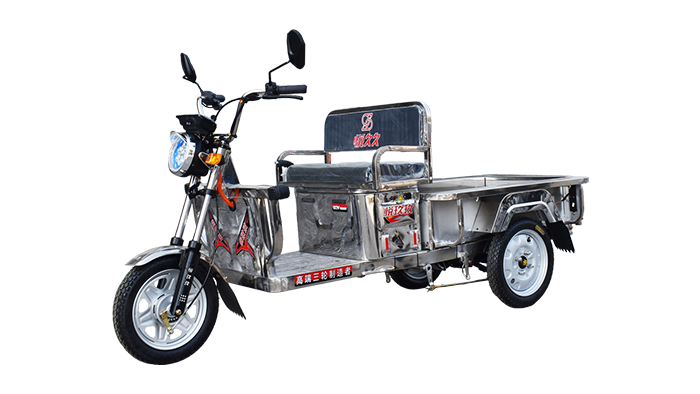
In short-haul transport between towns and villages, as well as in everyday personal transport, the electric tricycle has become an important tool thanks to its flexibility and economy. Yet users have long been troubled by two problems: traditional sheet-steel bodies rust easily, and plastic shells age quickly. In recent years, Stainless Steel Electric Tricycles have entered the mainstream, and their durability is being proven by more and more real-world use. Below we analyse why they last, from three angles: material properties, structural design and usage scenarios.
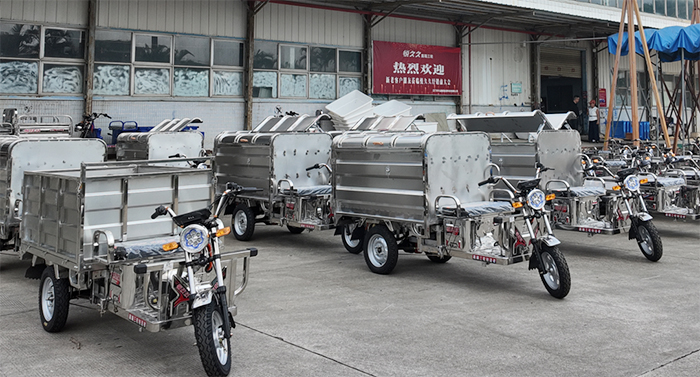
I. Corrosion Resistance: Solving Rust at Its Source
Conventional sheet-steel bodies rely on paint for rust protection, but everyday scrapes, acid rain and the high salt-spray environment of coastal regions easily strip the paint and oxidise the metal underneath. Data shows that after three years of use in a humid environment, ordinary sheet-steel tricycles can reach a rust rate of over 60%, directly compromising body strength and safety.
The core advantage of stainless steel lies in its alloying elements—chromium and nickel—which form a dense oxide film on the surface that self-repairs even when locally damaged. Salt-spray testing at a third-party laboratory found that after 1,000 hours of continuous exposure to a 5% sodium chloride solution, 304 stainless steel showed only slight discolouration with no penetrating rust. This inherent rust resistance removes the need for frequent repainting and extends service life to two or three times that of conventional materials.
II. Structural Strength: Balancing Load Capacity and Impact Resistance
Electric tricycles often carry goods or several passengers, so body rigidity is critical. The yield strength of stainless steel is 1.5 times that of ordinary carbon steel, and its excellent ductility allows it to be bent and stamped into complex structures, improving resistance to deformation while keeping weight down.
Take cargo box design as an example: stainless steel boxes use one-piece forming, avoiding the stress concentration of traditional welding. Even under long-term overloading they resist cracking. Field data from a logistics company showed that after two years of continuous use at a daily load of 500 kg and 50 km travelled, the frame deformation of a stainless steel tricycle was under 1%, while comparable sheet-steel models generally exceeded 3%.
III. Environmental Adaptability: Consistent Performance in All Climates
Electric tricycles are used in extreme environments ranging from high heat to severe cold and heavy rain, placing strict demands on material stability. The thermal expansion coefficient of stainless steel is only one third that of aluminium, so dimensional change between −40°C and 80°C is minimal, effectively preventing rattles or loose components caused by thermal cycling.
In coastal regions, high salt spray accelerates metal corrosion, yet the pitting resistance equivalent number (PREN) of stainless steel is generally above 30, far higher than the 12–18 of ordinary carbon steel. Even with long-term exposure to humid salt spray, key components such as the frame and hinges retain a service life of more than five years. In addition, the smooth stainless steel surface does not attract dust easily, cutting cleaning and maintenance costs by over 40%.
【Article Tags】 Stainless Electric Tricycle
【ResponsibilityEdit】
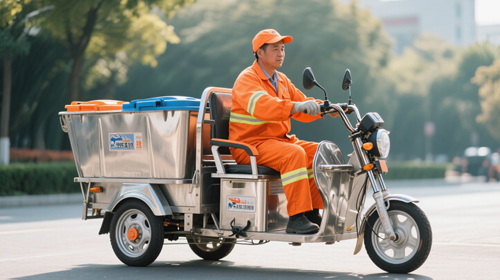
Product:1.5mAll-steelStainless SteelSanitation TricycleApplication:CitySanitationCleaningBack Streets of Yangchun County, Yangjiang, Guangdong... 【Details+】

Product:1.8mLoad Capacity KingStainless Steel Electric TricyclesApplication:FruitTransportationDatangbu, Xinfeng County, Ganzhou, Jiangxi... 【Details+】
 0750-6333776+86 133 9251 2305
All Rights Reserved © 2025 Jiangmen Jiuxin New Energy Technology Co., Ltd.Record No..:粤ICP备2025465897号 Sitemap

 WeChat Official Account
 Follow Douyin
 Follow Kuaishou
 Follow WeChat Channels
 Follow Xiaohongshu