Stainless Steel TricyclesInventor


+86 133 9251 2305
+86 133 9251 2305
Hot search keywords: Sanitation Tricyclesmanufacturer Stainless Steel Tricycles Custom Stainless Steel TricyclesPrice
In fields such as logistics and delivery, sanitation operations, and engineering support, special tricycles have become the preferred equipment for many scenarios thanks to their strong adaptability. Customizing such vehicles is meant to match operational needs, yet many users fall into misconceptions due to cognitive bias—causing a disconnect between the result and their expectations, and even adding unnecessary cost. To help, Yuejiujiu has compiled the five common misconceptions about custom special tricycles. Let's take a look together.
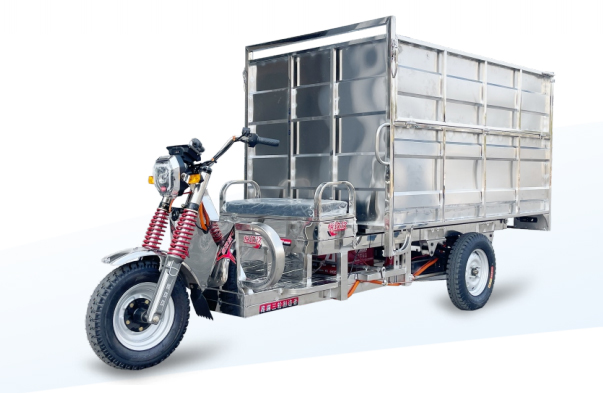
Misconception 1: Treating "Low Price" as the Core Selection Criterion
Some users focus excessively on the quote when customizing, neglecting how well the vehicle's core configuration matches their operational needs. The value of a custom special tricycle lies in key metrics such as load capacity, power system, and durability—all of which depend on a premium frame material, a properly matched power motor, and purpose-built components suited to the working conditions. If low-cost materials or under-specced parts are chosen to cut costs, the vehicle's structural strength and operational stability will drop directly, making failures likely under heavy-duty use. This in turn drives extra spending on frequent repairs, and the total cost ends up far exceeding the initial savings.
Misconception 2: Confusing "Personalized Decoration" with "Functional Customization"
Many users equate customization with superficial changes such as exterior color tweaks or decal designs, overlooking the core functional adaptation. A custom special tricycle should be deeply optimized around the operating scenario: sanitation vehicles need a layered waste-collection structure and a convenient tipping mechanism; engineering vehicles need mounting interfaces for dedicated equipment and a load-bearing layout; delivery vehicles need cargo-compartment zoning and fast loading/unloading lanes planned around the cargo's nature. Pursuing only appearance personalization while ignoring functional adaptation makes the vehicle struggle to meet core operational needs, trapping it in the "looks good but doesn't work well" dilemma.
Misconception 3: Ignoring Ease of Maintenance in the Later Stage
During customization, users often focus on the performance parameters at delivery, but ignore maintenance needs over long-term use. Daily maintenance involves many steps—filter replacement, motor servicing, circuit troubleshooting, and more. If maintainability isn't considered during customization, problems arise: a compact structural design leaves insufficient service space, and a scattered component layout adds disassembly steps. This not only lengthens each maintenance session and lowers operational efficiency, but can also damage the equipment's sealing or connection stability through frequent disassembly, indirectly affecting service life. Reasonable customization should embrace modular-design thinking, reserve dedicated service access, and simplify routine maintenance procedures.
Misconception 4: Limiting the Understanding of "Adaptability" to Size
Matching vehicle size to the operating space is only the foundation of adaptability; many scenario-specific adaptation factors are easily overlooked. Adaptability must be considered comprehensively against multiple properties of the operating environment: in areas with steep slopes, emphasis should be on the power system's climbing torque and the braking system's safety margin; in humid or watery environments, the electrical system's moisture-proof sealing and anti-corrosion treatment must be strengthened; in flammable or explosive settings, anti-static materials and explosion-proof power components are mandatory. Following only size adaptation while ignoring environment-specific demands will not only hurt operational efficiency but can also create safety hazards.
Misconception 5: Skipping the On-site Scenario Survey Before Ordering
Without on-site research into the operating scenario, relying only on verbal descriptions or experience to judge a customization plan easily leads to misjudged needs. Different scenarios differ in road conditions (e.g., smoothness, bump coefficient), operating intensity (e.g., average daily runtime, load frequency), and spatial constraints (e.g., aisle width, turning radius)—all of which directly determine the vehicle's core design direction. For example, narrow-area operation requires optimized steering flexibility, and dusty environments require strengthened air-filtration systems. Skipping the on-site survey, the customized vehicle may face problems such as inconvenient operation or excessive/insufficient performance, failing to deliver its adaptation value.
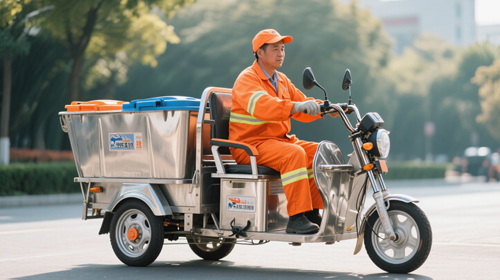
Product:1.5mAll-steelStainless SteelSanitation TricycleApplication:CitySanitationCleaningBack Streets of Yangchun County, Yangjiang, Guangdong... 【Details+】
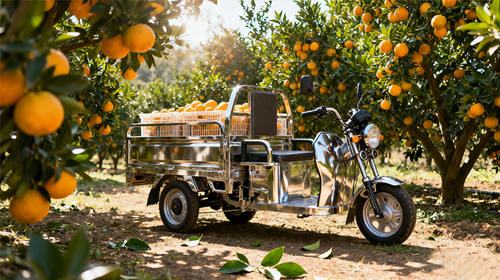
Product:1.8mLoad Capacity KingStainless Steel Electric TricyclesApplication:FruitTransportationDatangbu, Xinfeng County, Ganzhou, Jiangxi... 【Details+】
 0750-6333776+86 133 9251 2305
All Rights Reserved © 2025 Jiangmen Jiuxin New Energy Technology Co., Ltd.Record No..:粤ICP备2025465897号 Sitemap

 WeChat Official Account
 Follow Douyin
 Follow Kuaishou
 Follow WeChat Channels
 Follow Xiaohongshu